

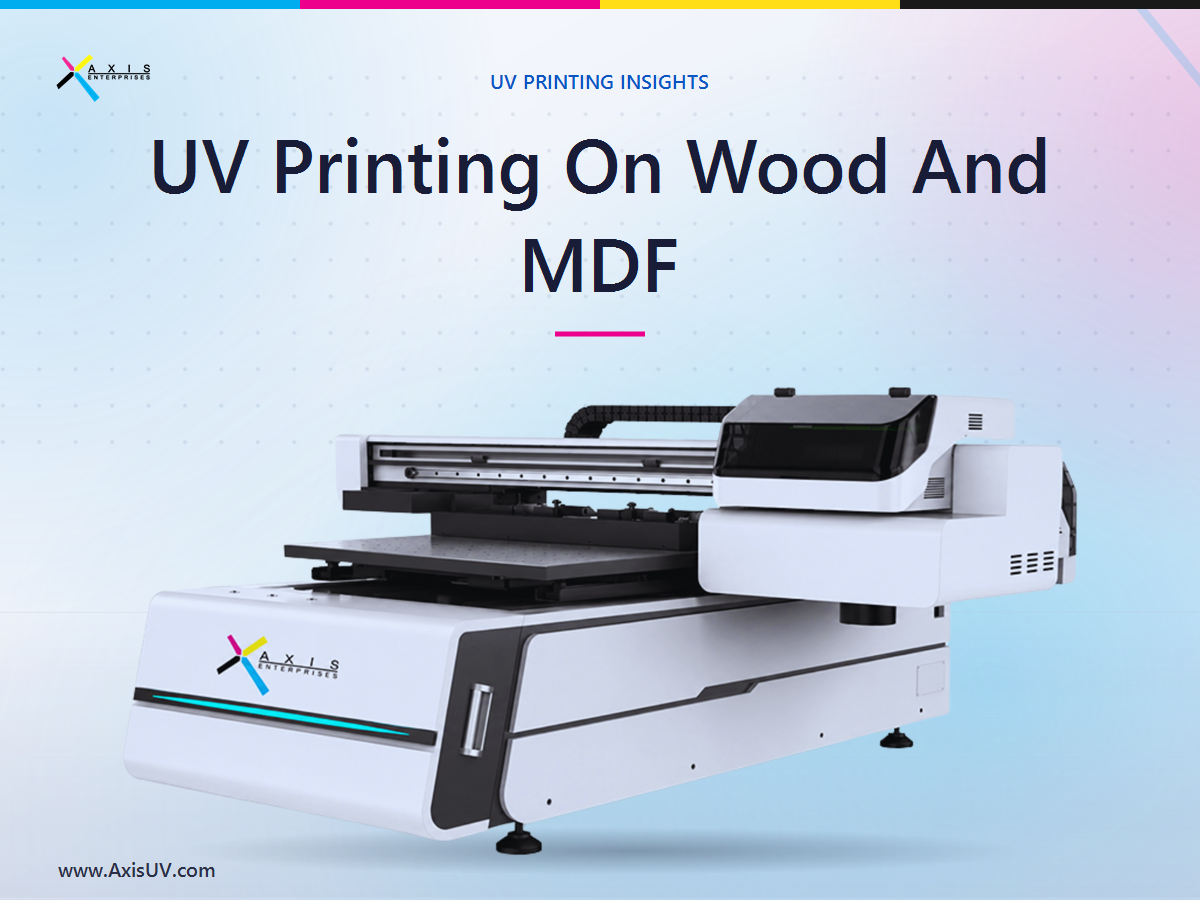
Wood is quietly becoming one of the most profitable surfaces in Indian short-run manufacturing, and most workshops still send every wooden job to an outside vendor. That single habit leaks margin every month.
Quick answer
Yes, a flatbed UV printer can print full-colour, photo-grade graphics directly onto natural wood, plywood, and MDF, with no screens, no minimum order quantity, and same-day turnaround. The ink sits on the surface and is hardened instantly by ultraviolet light, so the print is dry and touchable the moment it leaves the bed. To get durable, premium results on wood you need three things: a clean and lightly sanded surface, a white ink underbase on darker or porous grain, and the correct primer for engineered boards like MDF. Done right, a wooden coaster, plaque, sign, or gift box can move from a low-margin commodity to a high-margin customised product. For Indian buyers, the real decision is not whether the machine can print on wood (it can), but whether you choose a printer, ink system, and service partner that keep those wooden jobs profitable at scale.
Why wooden work is worth more than it looks
The demand signal is broad and growing. India’s home decor market was valued at roughly ₹2,26,415 crore (about USD 25.5 billion) in 2024 and is projected to reach USD 40.8 billion by 2033 at a compound annual growth rate of 5.4%, according to the India Brand Equity Foundation. Within handicrafts, woodware is the single largest category: it held about an 18% share of the Indian handicrafts market in 2025, per IMARC Group. Wooden furniture alone is estimated to account for 62.3% of India’s furniture market, which is forecast to climb from USD 30.6 billion in 2025 to USD 64.1 billion by 2032, as reported by Persistence Market Research.
Every one of those categories, decor, gifting, furniture, and signage, buys printed wood. Yet most of that printing is still outsourced or done with slow, single-colour methods.
Where most print shops leak margin on wood
The status quo has a real cost. Traditional routes to printed wood carry structural problems:
- Screen printing and pad printing need separate screens per colour and a minimum quantity, so a single customised plaque is not worth the setup.
- Stickers and laminates peel, bubble, and look cheap on premium wood, and they add a consumable cost to every unit.
- Outsourcing adds transport, vendor margin, and a two to seven day delay, which means you lose urgent and personalised orders that competitors accept.
For a small workshop, the pain is sharper still: you turn away the ₹500 single-piece gift order and the 40-unit corporate award batch because neither is economical to outsource. Those are exactly the orders with the fattest margins.
What changed: the technology caught up to short runs
The shift is driven by UV curing, a low-temperature process in which ultraviolet light instantly hardens the ink through polymerisation rather than evaporation. Paired with inkjet printheads, it lets a single flatbed machine lay down CMYK plus white and varnish directly onto wood in one pass. Because there are no screens and no drying racks, the economical batch size drops to one. India’s broader digital printing market reflects this move to short-run, on-demand work: it is projected to grow at a 7.8% compound annual rate to reach USD 2.9 billion by 2033, according to IMARC Group.
The surface science matters. Natural wood, plywood, and medium-density fibreboard (MDF) each behave differently: open-grain timber drinks ink, while a raw MDF edge is porous and uneven. The reliable recipe is to lightly sand the surface, apply a white primer or white ink underbase so colours stay vivid on dark or absorbent grain, then print. This is why two shops with the same printer can produce very different quality: the winner controls surface preparation, not just resolution.
What smart buyers should look for
If wooden work is part of your plan, judge a UV printer on the criteria that actually protect margin, not on headline price alone:
- White ink and varnish capability: without a white underbase, colour on dark wood looks dull. Varnish adds the tactile, premium finish that justifies higher pricing.
- Adhesion and cure quality: ask for a scratch and tape test on your own wood samples, since real durability shows on your material, not a demo board.
- Jig and repeatability support: repeat wooden products (coasters, name plates, awards) are far more profitable when fixtures make alignment fast and consistent.
- Total cost of ownership, not sticker price: weigh ink consumption, printhead life, spare-part pricing, and downtime. The honest number is the total cost of ownership, calculated per print over the machine’s life.
- Local service and GST-compliant invoicing: a machine that sits idle waiting for a part earns nothing, so response time and spare-part availability in India matter more than a small discount.
This buyer’s checklist matters because the surrounding markets are large and time-sensitive. India’s digital signage market alone reached USD 940.5 million in 2024 and is forecast to hit USD 3,415 million by 2033 at a 14.25% compound annual rate, per IMARC Group, and much of that work touches wood, acrylic, and board. With more than 7.83 crore enterprises now registered on the Udyam portal (a benchmark of India’s fast-formalising MSME base) reported by the Press Information Bureau, the number of businesses that could buy branded, printed wood from you keeps rising.
A better way forward
Bringing wood printing in-house is less about the machine and more about matching the right printer, ink set, and support to your product mix. That is the entire focus at Axis Enterprises. We supply flatbed UV printing machines built for Indian workshops and back them with lifetime technical support, so a printhead question at 9 pm does not become a week of lost production. You can explore our range of flatbed UV printers and see which configuration fits wood, MDF, acrylic, and metal work.
If you are weighing the numbers, we can help you calculate a realistic per-print cost on your own wooden products before you commit. Our team walks new buyers through material tests, white-ink and varnish options, and GST-aware costing on a free machine buying consultation. For workshops already outsourcing wooden jobs, we can show what the same volume looks like produced in-house, including the primers and jigs that keep quality consistent, when you request a live UV printing demo.
Frequently asked questions
Can UV printers print directly on natural wood?
Yes. A flatbed UV printer prints full-colour graphics directly onto natural wood without stickers or laminates. Light sanding and a white ink underbase on darker or open-grain timber give the most vivid, durable result.
Do wood and MDF need surface preparation before printing?
Almost always. Raw MDF edges and porous timber should be cleaned, lightly sanded, and primed (or given a white ink base) so ink adheres evenly and colours stay bright. Sealed or pre-coated boards print more predictably than raw absorbent surfaces.
Can I print on plywood and MDF, not just solid wood?
Yes. Plywood, MDF, HDF, and laminated boards all print well on a UV flatbed. Engineered boards are often easier than solid timber because their surface is flatter and more uniform, which improves alignment and consistency for repeat products.
Can UV printing replace screen printing on wood?
For short runs and personalised work, yes. UV printing removes screens and minimum quantities, so a single custom plaque or a 20-piece award batch becomes profitable. High-volume single-colour jobs may still suit screen printing, but most customised wooden work is faster and cheaper on a UV flatbed.
Which wooden products offer the highest margins?
Personalised and gift-oriented items typically earn the most: awards and trophies, name plates, photo frames, coasters, wedding and corporate gifts, and branded signage. These sell on design and finish rather than raw material cost, which is where UV white ink and varnish add clear value.
Next step
If your business already touches decor, gifting, furniture, or signage, wooden jobs are almost certainly leaving your workshop and taking their margin with them. The practical next move is simple: test your own wood on the right machine and see the per-print economics for yourself. You are welcome to bring your products and questions to a no-pressure UV printing machine buying consultation, and decide from there whether bringing this work in-house makes sense for you.
Sources
- India Brand Equity Foundation (IBEF): India Home Decor Industry
- IMARC Group: India Handicrafts Market
- Persistence Market Research: India Furniture Market
- IMARC Group: India Digital Printing Market
- IMARC Group: India Digital Signage Market
- Press Information Bureau, Government of India: Udyam Registration figures