

Published: July 20, 2026 | Last updated: July 20, 2026
Quick answer
The right time to buy your first UV printer is when your business shows three or more of these five signals: you spend a consistent amount every month on outsourced printing, customers regularly ask for materials or products you cannot print, you lose orders because of slow turnaround, your margins on standard print work keep shrinking, and you have the space and one trainable person to run a machine. Timing matters because the print market is splitting: the broader India commercial printing market is growing at only 2.76 percent a year according to IMARC Group, while India’s digital printing segment is growing at 7.8 percent. Businesses that move to in-house digital capability early capture the growth side of that split. The rest compete for a slowly shrinking pool of conventional work.
What is a UV printer?
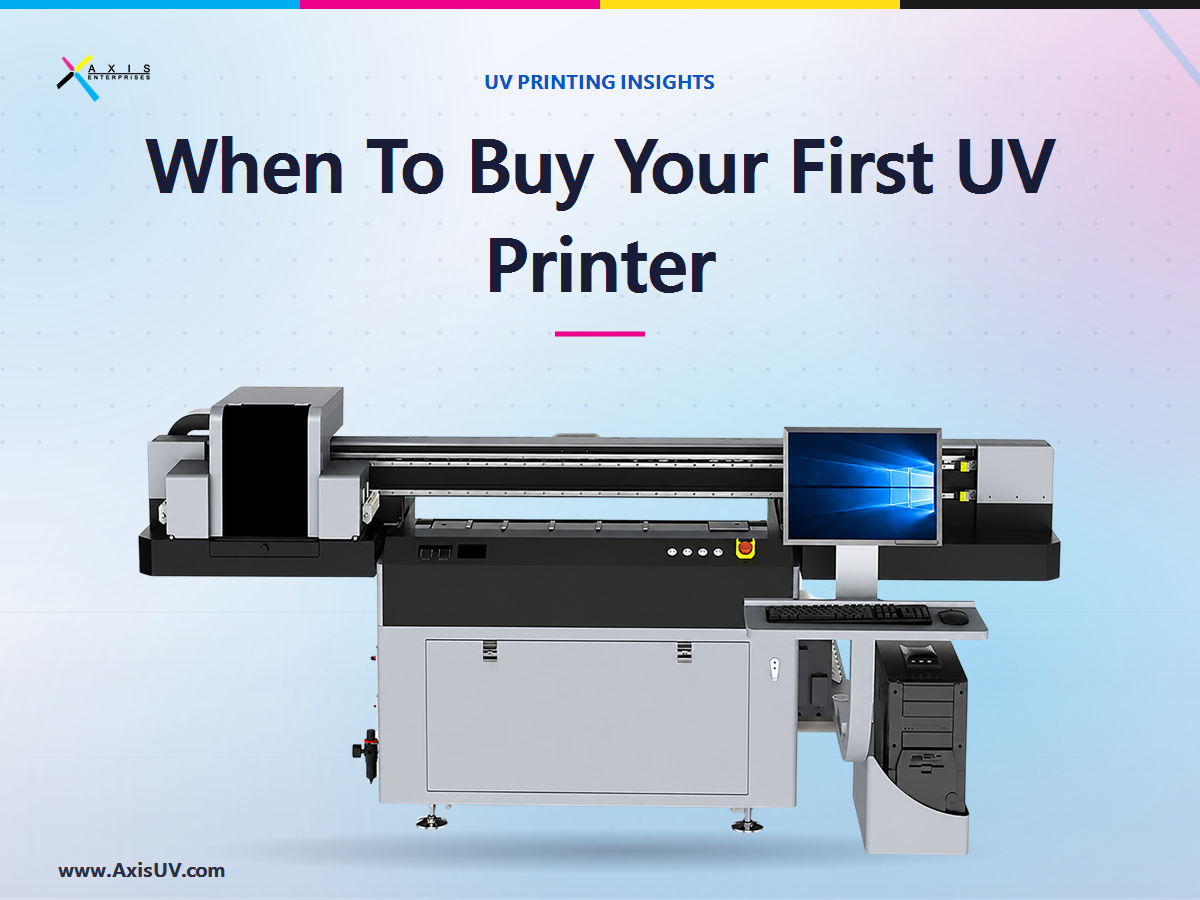
A UV printer is a digital inkjet printing machine that uses ultraviolet light to instantly dry, or cure, ink as it lands on the surface. This process, known as UV curing, lets the machine print directly on plastics, glass, metal, wood, acrylic, leather, and hundreds of other rigid and flexible materials.
Because the ink cures in place instead of soaking in, a UV printer produces sharp, durable, raised-texture prints on objects a normal printer cannot touch. That is why it powers signage, gifting, packaging, industrial marking, and product personalization businesses.
Why does timing matter so much right now?
Timing matters because demand is moving toward exactly the kind of work UV printers do. The global UV inkjet printing market is projected to grow from 60.09 billion US dollars in 2025 to 92.82 billion US dollars by 2030, a compound growth rate of 8.9 percent, according to The Business Research Company. Supporting that shift, Mordor Intelligence estimates the UV cured printing inks market will rise from 1.75 billion US dollars in 2025 to 2.49 billion US dollars by 2030.
India is following the same curve. IMARC Group projects India’s digital printing market will grow at 7.8 percent annually through 2033 to reach 2.9 billion US dollars, nearly three times the growth rate of the overall commercial printing market.
Personalization is a major engine behind these numbers. Bonafide Research estimates India’s personalized gift market alone will add over 540 million US dollars in sales by 2029, driven by festivals, weddings, and corporate demand for customized products.
What does this mean for a small business owner?
It means the safest looking choice, continuing to outsource, is quietly becoming the riskiest one. Every outsourced job hands away margin, adds days to delivery, and trains your customer to accept whatever your vendor can produce.
This pressure lands hardest on India’s small and mid-sized firms. Micro, small and medium enterprises contribute about 30.1 percent of India’s GDP and 35.4 percent of manufacturing output, according to the Government of India’s Press Information Bureau, yet most compete in crowded categories where price is the only lever. In-house customization capability is one of the few practical ways for a firm of 30 to 5,000 people to escape pure price competition.
The question is not whether digital, direct-to-object printing will keep growing. The data above settles that. The question is whether your business is ready to own the capability, and that is a readiness question, not a courage question.
What are the five signs your business is ready for its first UV printer?
You are ready when the machine would replace money you already spend and capture orders you already lose. Check your last three months of business against this table.
Three or more signals present means waiting has a real monthly cost. One or two signals means build demand first: collect enquiries, test designs with an outsourced partner, and revisit the decision in a quarter.
What should a first-time buyer look for in a UV printer?
A first-time buyer should evaluate the total cost of owning the machine, not the sticker price. Total cost of ownership includes ink and consumables, print head life, power, maintenance, and downtime, and it decides your real cost per print far more than the purchase price does.
- Match bed size to your actual orders. Buy for the products you will print in year one, not the largest job you can imagine.
- Insist on a live demo with your own products. Print on your acrylic, your bottles, your wood samples before you commit.
- Check service reach and spare parts availability in India. A machine that waits two weeks for a part erases its own savings.
- Ask for operator training as part of the deal. Skill transfer, not just installation, determines how fast you reach production quality.
- Demand a proper GST invoice and clear warranty terms. As business capital equipment, a correctly invoiced machine also supports your input tax credit claim, which your tax advisor can confirm for your situation.
- Model your payback before you buy. Estimate monthly print volume and compare against your current outsourcing spend to project your return on investment honestly.
A better way to make the decision
Everything above points to one conclusion: the buying decision should start with your numbers, not with a machine catalogue. That is the approach we take at Axis Enterprises, where we help Indian business owners map their outsourcing spend, product mix, and growth plans to the right UV printing machine instead of pushing the biggest model.
If you are working through this decision, you can explore UV printing machines and buying guidance at uvprinterindia.com and see how machines differ by bed size, ink configuration, and application before speaking to anyone.
Frequently asked questions
Is a UV printer worth it for a small business in India?
A UV printer is worth it when it replaces existing outsourcing spend and unlocks orders you currently refuse. With India’s digital printing segment growing at 7.8 percent annually per IMARC Group, small firms that own customization capability are positioned on the growing side of the market. If you have no current print spend and no customer enquiries, build demand first.
What materials can a UV printer print on?
UV printers print directly on acrylic, glass, metal, wood, MDF, plastics, leather, ceramic, and most rigid or flexible flat surfaces. With the right jig, they also print on cylindrical objects like bottles and pens. This range comes from UV curing, which hardens ink on the surface instead of absorbing it into the material.
Do I need printing experience to operate a UV printer?
No prior printing experience is required. A computer-literate operator can learn file preparation, machine calibration, and daily maintenance through structured training, typically within a few weeks of consistent use. What matters is choosing a supplier who includes hands-on training, which is one reason buyers talk to a UV printer specialist before finalizing a machine.
Should I buy a UV printer or keep outsourcing?
Keep outsourcing while your monthly print spend is small and irregular. Switch to owning when spend is consistent, turnaround is costing you orders, or customers want products your vendor cannot produce. The five-signal checklist above turns this into a measurable decision instead of a guess.
How do I estimate the payback period on my first UV printer?
Add your monthly outsourcing spend to the estimated value of orders you currently refuse, then subtract projected ink, power, and maintenance costs. Divide the machine investment by that monthly figure to get an approximate payback window in months. Run this with real quotations and your own volumes rather than brochure assumptions.
Next step
If three or more readiness signals apply to your business, the most useful next move is a structured conversation about your numbers, your products, and the machine class that fits them. You can book a free UV Printing Machine Buying Consultation at uvprinterindia.com, walk through your outsourcing costs and product mix, and leave with a clear picture of whether this is your year to buy, no purchase required.
Sources
- The Business Research Company: UV Inkjet Printing Global Market Report
- Mordor Intelligence: UV Cured Printing Inks Market
- IMARC Group: India Digital Printing Market
- IMARC Group: India Commercial Printing Market
- Press Information Bureau, Government of India: MSME sector contribution to GDP, manufacturing and exports
- Bonafide Research: India Personalized Gifts Market