

Published: July 19, 2026
Quick answer
India’s corporate gifting segment is projected to grow from about ₹12,000 crore in 2022 to roughly ₹18,000 crore by 2027, according to a 2026 statistics roundup by TapWell, and the fastest growing demand within it is for personalized, branded products. Small print shops, signage businesses, and manufacturers can enter this market profitably because personalization work is priced on perceived value, not on print area. The practical entry route is in-house direct-to-object printing, which removes minimum order quantities and lets a business accept one-piece orders, such as a single named diary, a logo bottle, or a photo on wood. This article explains the market data, why most print businesses currently miss these orders, and what capabilities a smart buyer should look for before investing in equipment.
How big is the corporate gifting opportunity in India?
Corporate gifting in India is already a five-figure crore market and is growing faster than general gifting. The 2026 corporate gifting statistics compiled by TapWell place the segment at about ₹12,000 crore in 2022, projected to reach roughly ₹18,000 crore (about USD 2.17 billion) by 2027, an increase of around 50 percent in five years.
The broader context is just as strong. TechSci Research valued India’s overall gifting market at USD 75.16 billion in 2024, with a forecast of USD 92.32 billion by 2030. Globally, a Consainsights market study projects corporate gifting to grow from USD 78 billion in 2023 to USD 169.09 billion by 2033, a 7.8 percent compound annual growth rate.
Corporate buying is also becoming structured. Per the same TapWell roundup, 67 percent of companies now operate with a defined gifting budget. Budgeted spending is repeat spending, and repeat spending rewards suppliers who can deliver reliably every festive season, including Diwali, New Year, onboarding cycles, and annual events.
Why do most print and signage businesses miss these orders?
Most small print businesses miss gifting orders because their equipment was built for flat media and volume runs, not for personalized objects in small quantities. A shop set up for banners, boards, and paper struggles the moment a client asks for 200 pens with individual employee names, or 50 wooden desk plaques with different photos.
Three specific gaps show up again and again:
- Minimum order economics. Screen printing and pad printing need plates, screens, and setup time, so vendors impose minimum quantities. Corporate buyers increasingly want small, varied, personalized batches instead.
- Material limits. Gifting products are made of plastic, metal, glass, wood, leather, and acrylic. Conventional print setups cannot mark most of these surfaces directly.
- Outsourcing dependence. Shops that accept gifting jobs and outsource them give away margin, lose control of deadlines in peak season, and expose their client list to the vendor who actually prints the work.
The cost of these gaps is not theoretical. TapWell’s roundup reports that unique corporate gifts are 2.3 times more likely to influence a favorable business action, and that 73 percent of buyers say originality and packaging directly affect their purchase decision. The orders exist. They simply flow past businesses that cannot personalize.
What is driving demand for personalized corporate gifts?
Personalization is driving demand because buyers pay more for items that feel individually made. Research published by Deloitte Digital found that 80 percent of consumers surveyed prefer brands that offer personalized experiences and report spending around 50 percent more with those brands. Corporate buyers behave the same way: a bottle with the recipient’s own name outperforms a generic logo bottle at nearly the same production cost.
The product category itself is expanding. Stellar Market Research values the global personalized gifts market at USD 31.48 billion in 2024 and projects it to reach nearly USD 60.47 billion by 2032, an 8.5 percent compound annual growth rate. Personalized items sit at the premium end of promotional merchandise, which is exactly where margins live for a small supplier.
For an Indian SMB, the takeaway is simple: the market is not asking for cheaper generic gifts. It is asking for one-piece and small-batch personalization, delivered fast, on real materials.
How does direct-to-object UV printing make personalization profitable?
UV printing makes personalization profitable because it prints digitally, directly on the object, with no plates, no screens, and no minimum quantity. A UV printer is an inkjet system whose inks harden instantly under ultraviolet light, a process called UV curing. Because the ink cures on contact, it bonds to acrylic, wood, glass, metal, leather, MDF, and plastic, which covers most gifting products sold in India.
Each print is generated from a digital file, so piece number one and piece number two hundred can carry different names, photos, or messages at no extra setup cost. White ink layers make colors pop on dark or transparent products, and varnish layers add raised, embossed-feel textures that buyers associate with premium gifts.
This is why equipment demand is climbing worldwide. Mordor Intelligence values the global UV printers market at USD 1.02 billion in 2025 and projects USD 1.58 billion by 2031, growing at 7.59 percent annually.
Here is how the two entry routes compare for a gifting order:
On the compliance side, a UV printer bought for business use is a capital good, and a GST-registered business can generally claim input tax credit on it under Goods and Services Tax rules. Confirm the treatment with your chartered accountant before purchase, and always compare machine quotes on a GST-inclusive, landed-cost basis.
What should a smart buyer look for in a UV printer for gifting work?
The right machine for gifting work is judged on five practical criteria, not on brochure specifications:
- True multi-surface capability. Ask for live prints on the actual products you plan to sell: pens, bottles, diaries, acrylic, wood, and glass, not just a demo sheet.
- White ink and varnish as working features. Premium gifting depends on white underbase and textured varnish. Check that both run reliably, not only in sample files.
- Variable data workflow. The software should merge a name list into a print layout, so 500 personalized pieces do not require 500 manual file edits.
- Uptime support in your geography. Festive season is unforgiving. Ask who services the machine, where spare printheads come from, and how fast an engineer reaches your city.
- Honest cost-per-print math. Get ink consumption figures for typical gift-sized prints and build your quote sheet before you buy, on a GST-aware landed cost.
A vendor who welcomes these five checks is telling you something important about how they will behave after the sale.
A better way to enter the gifting market
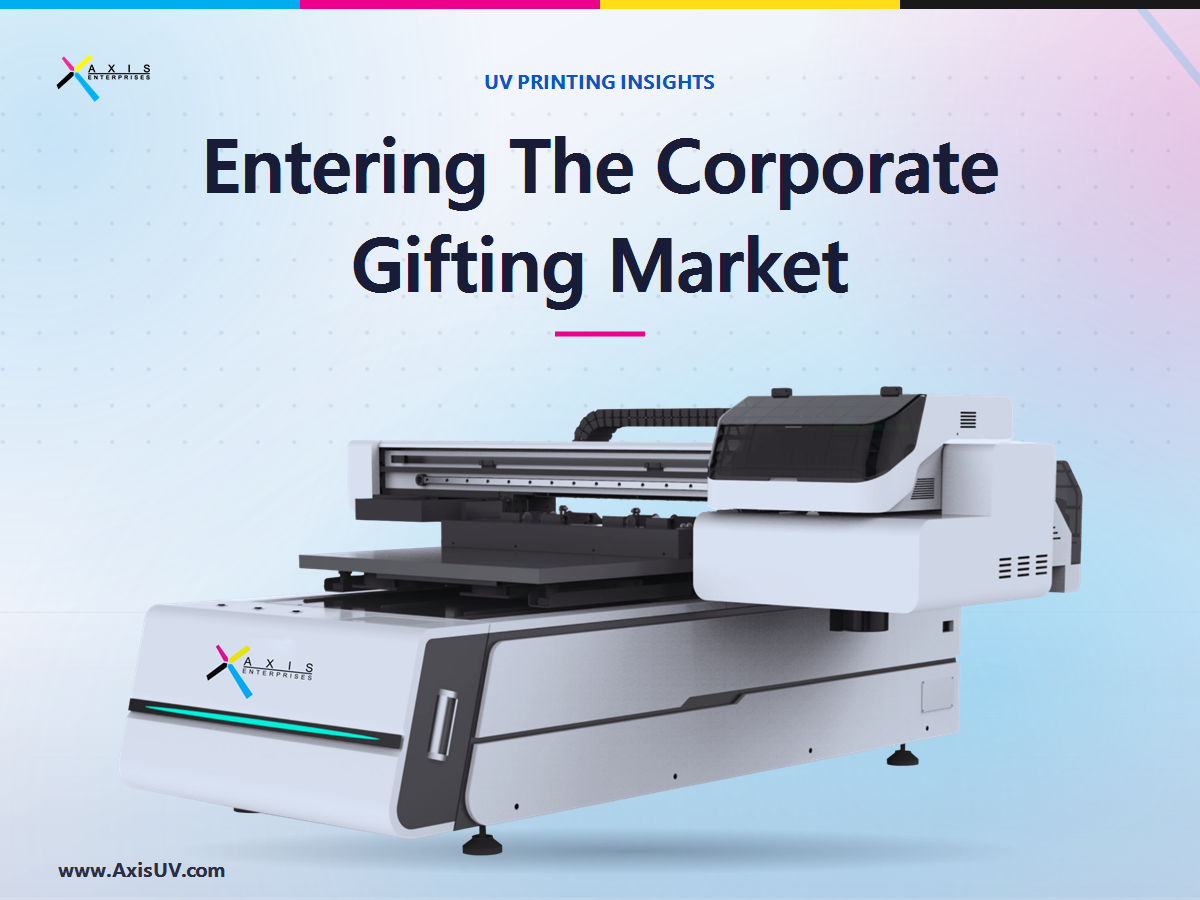
Given everything above, the lowest-risk entry into corporate gifting is a focused in-house setup: one flatbed UV printer, a starter catalog of 15 to 20 proven gift products, and a pricing sheet built on real ink costs. This is the exact path we help buyers plan at Axis Enterprises, where you can explore UV flatbed printers suited to gifting and product customization.
Because the machine prints one piece as easily as one thousand, you can serve a walk-in customer who wants a single personalized photo frame in the morning and a company ordering 300 named Diwali hampers in the afternoon, on the same equipment. Buyers who want help matching machine size, ink configuration, and budget to their product plan can talk to the Axis Enterprises team before shortlisting anything.
Next step
If corporate gifting is a market you want to enter this festive season, start with numbers rather than a machine brochure. Book a free UV Printing Machine Buying Consultation at uvprinterindia.com. Bring your target products and monthly volumes, and you will leave with a clear picture of machine options, realistic cost per print, and whether the investment fits your business today. You can also request a live demo on your own products so the decision is based on evidence, not promises.
Frequently asked questions
Is corporate gifting still a profitable business in India?
Yes. India’s corporate gifting segment is projected to grow from about ₹12,000 crore in 2022 to roughly ₹18,000 crore by 2027, per TapWell’s 2026 statistics roundup, and 67 percent of companies now maintain a defined gifting budget. Profitability concentrates in personalized and premium-finish products, where prices reflect perceived value rather than material cost.
Can a small business enter corporate gifting?
Yes. Corporate gifting orders are typically small batches with high customization, which suits a small in-house setup better than a mass production line. A single-machine shop with a focused product catalog can serve local companies, schools, event planners, and wedding buyers without a sales team, starting from its existing customer base.
Can I enter corporate gifting with one machine?
Yes, one flatbed UV printer can cover most standard gifting products, including pens, diaries, bottles, frames, awards, and boxes, because it prints directly on plastic, metal, glass, wood, leather, and acrylic. Businesses usually add a second machine only after peak-season demand consistently exceeds single-machine capacity.
Can I offer one-piece personalized gifts profitably?
Yes. Digital direct-to-object printing has no setup plates or screens, so a single piece costs only ink, electricity, and minutes of machine time. One-piece orders for names, photos, and messages are usually the highest-margin work a gifting business does, since customers pay for uniqueness.
How do I price customized gifts?
Price from perceived value, not from print area. A common approach is: product cost plus printing cost (ink and time) plus personalization premium, keeping the final price meaningfully below what the buyer would pay a metro gifting agency. Always quote GST-inclusive for corporate clients, since they will claim input credit on your invoice.
Sources
- TapWell: 17 Corporate Gifting Statistics You Need To Know In 2026
- TechSci Research: India Gifting Market Size, Growth and Outlook 2030
- Consainsights: Corporate Gifting Market Study 2023 to 2033
- Deloitte Digital: Personalizing Brand Experiences Research
- Stellar Market Research: Personalized Gifts Market Analysis and Forecast 2025 to 2032
- Mordor Intelligence: UV Printers Market Size and Growth Trends