

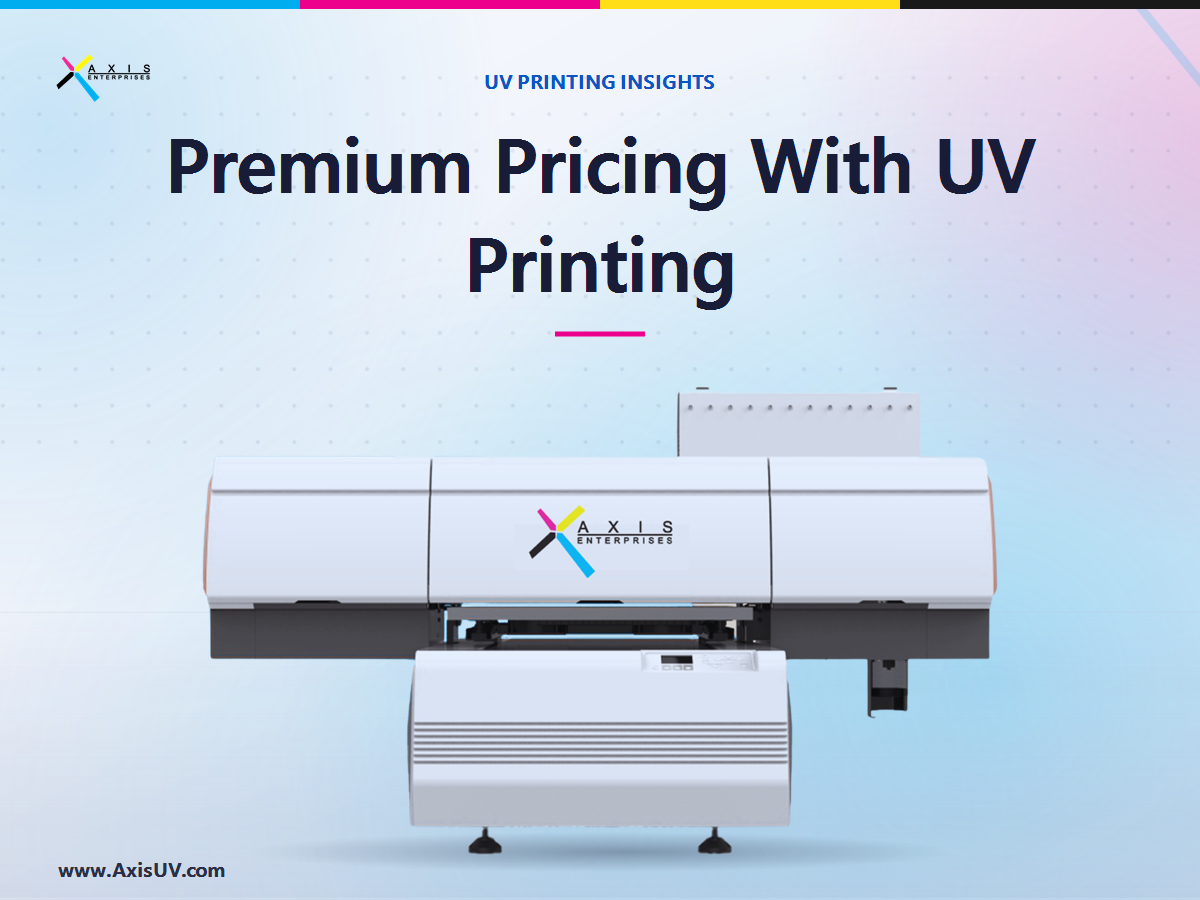
Quick answer: The most reliable way for a printing or product business to charge premium prices is to stop selling commodity output and start selling value-added work: personalized products, textured and embossed finishes, white ink and spot varnish effects, and direct-to-object printing. Research cited by WhatTheyThink shows print buyers will pay 24 to 89 percent more for pieces with special effects beyond standard CMYK. Deloitte’s consumer research found 1 in 5 consumers interested in personalised products will pay a 20 percent premium. And because price flows almost entirely to the bottom line, McKinsey estimates that a 1 percent price improvement lifts operating profit by roughly 8 percent for a typical company. The capability that unlocks these premiums in practice is value-added production, and UV printing is one of the most direct routes to it.
Price is the most powerful profit lever most owners never pull
According to McKinsey’s research on the power of pricing, a 1 percent price increase, with volumes stable, generates about an 8 percent increase in operating profit for an average company. That impact is nearly 50 percent greater than cutting variable costs by 1 percent, and more than three times greater than growing volume by 1 percent.
The same research carries a warning for anyone tempted to win work by quoting lower: to offset the profit lost from a 5 percent price cut, volumes would have to rise by 18.7 percent. That kind of demand response is extremely rare in any market. A strategy built on cutting prices to win volume is, in McKinsey’s words, generally doomed to failure.
Yet in most Indian print and product businesses, pricing is exactly where the least attention goes. Quotes are built as cost plus a thin margin, and the margin shrinks every time a competitor down the road buys the same machine.
Why the Indian print market punishes commodity work
The structural problem is commoditization: when every supplier offers the same output, buyers choose on price alone. India’s commercial printing market illustrates this clearly. IMARC Group values the India commercial printing market at USD 36.53 billion in 2025, growing to a projected USD 46.65 billion by 2034, a modest 2.76 percent annual rate. IMARC describes the industry as highly fragmented, with price-based competition reducing profit margins and volatile costs of paper, ink, and substrates compressing them further.
Read those two facts together. The pie is growing slowly, and the number of hands reaching for it is large. In that environment, a business selling standard inkjet or offset output on standard media has no defensible position. Someone will always quote lower.
What this means for signage shops, gift makers, and packaging printers
If you run a signage shop, a promotional products or corporate gifting business, a packaging or label unit, or a small manufacturing operation, you have probably felt this in three specific ways:
- Quoting wars. Every enquiry now comes with three competing quotes, and the buyer’s opening line is the other shop’s price.
- Margins that GST-compliant invoicing makes visible. Once you price transparently with GST, there is nowhere to hide a weak margin. Thin pricing shows up directly in your working capital.
- Growth that adds work but not profit. You win more jobs each year, run machines longer, hire more operators, and the net profit line barely moves.
None of these are effort problems. They are positioning problems. The work itself is interchangeable, so the price is negotiable.
What buyers actually pay more for
The encouraging news is that the same buyers who squeeze commodity quotes pay willingly, even happily, for work they perceive as different. The evidence for this is specific and measurable.
Special effects command large premiums. Research summarized by WhatTheyThink’s analysis of the print embellishment business found that print buyers are willing to pay anywhere from 24 percent up to 89 percent more for printed pieces that include special effects beyond CMYK: raised texture, spot gloss, foil-like finishes, and dimensional embellishment. A study released by the Foil and Specialty Effects Association, reported by WhatTheyThink, found an embellished direct mail piece produced a 31 percent higher response rate than the identical piece without embellishment, which is why brand buyers treat these finishes as an investment rather than a cost.
Personalization carries its own premium. Deloitte’s consumer review on mass personalisation found that 1 in 5 consumers interested in personalised products or services are willing to pay a 20 percent premium for them. Personalization converts a generic item into a one-of-one item, and one-of-one items have no comparison price.
The Indian gifting market is moving the same direction. TechSci Research values India’s gifting market at USD 75.16 billion in 2024, projected to reach USD 92.32 billion by 2030, and identifies personalized and premium gifting as a defining trend, driven by platforms offering engraving, custom printing, and bespoke products.
The pattern across all three data sets is the same: buyers resist paying more for the same thing, and accept paying more for a different thing. Texture, white ink highlights, varnish effects, and personal customization are what make a printed product read as a different thing.
The real shift: sell outcomes and effects, not square feet
This is where pricing strategy and production capability meet. Value-based pricing means setting price against what the output is worth to the buyer, not what it cost you to produce. A plain acrylic nameplate is worth a little more than the acrylic. A nameplate with raised tactile lettering, a spot varnish logo, and the client’s brand color matched exactly is worth what it does for the client’s reception area, and it is quoted accordingly.
Practically, value-added print capability comes from a small set of technical features. UV printing, which cures ink instantly using UV curing, is the technology that puts most of them in one machine: printing directly on wood, glass, acrylic, metal, leather, and ceramic; white ink for opaque printing on dark and transparent surfaces; clear varnish for gloss highlights; and layered ink for embossed, raised-texture effects. Each of those features is a price lever, because each one produces output a commodity printer cannot match.
What smart buyers should look for in a machine
If the goal is premium pricing rather than volume, evaluate any UV printer purchase against these criteria:
- White ink and varnish channels as standard, not costly add-ons, since these two channels create most premium effects.
- True multi-surface capability, including rigid and cylindrical objects, so you can serve gifting, signage, packaging, and industrial jobs from one asset.
- Texture and layered printing support, which enables embossed finishes that carry the highest documented premiums.
- Economical short runs, because personalization means run lengths of one, and setup cost per piece decides whether those jobs are profitable.
- Local service and operator training, since premium clients tolerate zero delivery delays, and downtime support in India matters more than brochure specifications.
- A supplier who understands applications, not just hardware, and can show you which premium products your market will actually buy.
A better way forward
This is the approach we built Axis Enterprises around. Rather than selling machines on speed and price, we help Indian businesses choose UV printing equipment based on the premium applications they intend to sell: personalized gifts, textured signage, branded packaging, industrial marking, and custom interior products. You can explore UV printing machines suited to value-added work and see the kinds of applications each configuration supports.
Because the machine is only half the decision, we also advise on the application side: which effects command premiums in your city, what white ink and varnish add to a quote, and how to structure pricing so you capture the value your output creates. If you are comparing options, it helps to review flatbed and roll configurations side by side before committing capital.
Next step
If your business is stuck quoting against competitors on identical work, the fastest way out is a clear-eyed look at what premium applications your market will pay for and what equipment unlocks them. You can book a free UV Printing Machine Buying Consultation with the Axis Enterprises team. Bring your current product list and typical quote values, and we will map which value-added applications fit your customers, what a realistic premium price band looks like, and which machine configuration gets you there without overspending. There is no cost and no obligation, just a working session on your UV printing options.
Frequently asked questions
Why do some customers happily pay premium prices?
Because they are buying an outcome, not a print. A personalized or embellished product carries emotional value, brand value, or exclusivity that a standard product does not. Deloitte’s research found 1 in 5 consumers interested in personalised products will pay a 20 percent premium, and embellishment research cited by WhatTheyThink shows buyers paying 24 to 89 percent more for special print effects. When output is unique, there is no competing quote to compare it against.
Which customers are willing to pay premium prices for UV printing?
Corporate gifting buyers, wedding and event planners, architects and interior designers, luxury packaging brands, awards and trophy buyers, and businesses ordering branded merchandise. These segments buy on impact and deadline reliability, not per-piece price, and they routinely accept premiums for texture, white ink on dark materials, and personalization.
Can texture and varnish justify premium pricing?
Yes, and they are the strongest levers available. Raised texture and spot varnish are the effects behind the 24 to 89 percent premium range reported for embellished print, and an FSEA study found embellished pieces produced a 31 percent higher response rate in direct mail. Both effects are produced digitally on a UV printer with clear ink layering, so the premium comes with minimal extra material cost.
Which packaging upgrades justify premium pricing?
Spot gloss highlights on logos, raised tactile lettering, white ink printing on kraft and colored boxes, and short-run personalized packaging for gifting and D2C brands. Packaging with enhanced finishes is perceived as significantly higher quality by consumers, which is why brands pay printers more for it.
Is premium pricing realistic for a small shop competing with large printers?
It is more realistic for a small shop than for a large one. Premium work is short-run, customized, and service-heavy, which suits a small team with a versatile machine. Large volume printers are optimized for long identical runs and struggle to profitably serve run lengths of one. A small shop with white ink, varnish, and multi-surface capability competes in a segment where the large printer’s scale advantage disappears.
Sources
- McKinsey and Company, The Power of Pricing
- Deloitte Consumer Review, Made-to-Order: The Rise of Mass Personalisation
- WhatTheyThink Quarterly, Crafting a Winning Business Plan for Print Embellishments
- WhatTheyThink, FSEA Study Results on Direct Mail and Print Embellishments
- IMARC Group, India Commercial Printing Market Report
- TechSci Research, India Gifting Market Forecast