

Quick answer
Every outsourced print job carries a hidden payroll cost: staff hours spent preparing files for vendors, negotiating rates, chasing deliveries, inspecting returned goods, and redoing rejected pieces. Bringing printing in-house with an automated UV flatbed printer removes most of that coordination work. One trained operator can load a product, start a print, and move to other tasks while the machine prints and cures in a single pass. For a typical Indian SMB doing regular customization or branding work, this converts several person-days per month of coordination into machine time, cuts dependence on vendor schedules, and lets the same team handle more orders without new hires. The rest of this article shows the data behind that claim and what to check before you buy.
The hidden payroll inside every outsourced print job
Here is a number most business owners have never connected to their printing bills. Research by the McKinsey Global Institute found that about 60 percent of all occupations have at least 30 percent of their activities that could be automated with technology that already exists. Coordination work, the kind your team does every time a print job goes to an outside vendor, sits squarely in that automatable zone.
The scale of routine work inside ordinary businesses is larger than most owners assume:
- A typical office worker spends about 10 percent of their time on manual data entry and over 50 percent of their total work time creating or updating documents, according to 2024 research by ProcessMaker based on more than 4 million workplace data points.
- The same study found the average employee performs over 1,000 copy-paste actions every week, roughly 52,000 a year, much of it moving job details between emails, spreadsheets, and vendor messages.
- McKinsey’s research on the future of work concludes that predictable, repetitive physical and data-handling activities are the most automatable categories of all.
None of this shows up as a line item on a vendor invoice. It shows up as salaries paid for hours spent managing vendors instead of serving customers.
Where the hours actually go when you outsource
Walk through one outsourced customization order and count the touches. Someone prepares the artwork and sends it. Someone follows up because the vendor has not confirmed. Someone negotiates the rate because quantities changed. Someone arranges transport both ways. Someone inspects the delivered pieces, finds a colour mismatch on a few, photographs them, argues about the rework, and repeats part of the cycle. For a business running 10 to 30 outsourced jobs a month, this is easily a part-time job hidden across two or three salaries, plus the owner’s own attention, which is the most expensive hour in the company.
This is the specific pain of automation that most equipment discussions miss. The question is not only “how fast does the machine print”. It is “how much human coordination does the machine eliminate”.
What this means for Indian SMB owners
For Indian founders and factory owners, three pressures make this worse every year. First, customer expectations have shifted to short runs, personalization, and fast delivery, so the number of small jobs (and therefore the number of coordination cycles) keeps rising. India’s print-on-demand market is projected to grow from USD 833.5 million in 2025 to about USD 5,931 million by 2033, a 27.8 percent annual growth rate, according to Straits Research. More small orders means more vendor round-trips if you outsource.
Second, the market around you is automating. India’s industrial automation market was valued at USD 7.57 billion (roughly ₹65,000 crore) in 2024 and is growing at about 9.5 percent annually through 2030, per Nexdigm market research. Competitors who automate quote faster, deliver faster, and absorb wage inflation better.
Third, digital print capacity itself is expanding. IMARC Group values India’s digital printing market at USD 1.4 billion in 2024, headed to USD 2.9 billion by 2033, and Grand View Research projects around 9.1 percent annual growth in the segment through 2030. The businesses capturing that growth are largely the ones producing in-house.
How UV printing automates the work, not just the printing
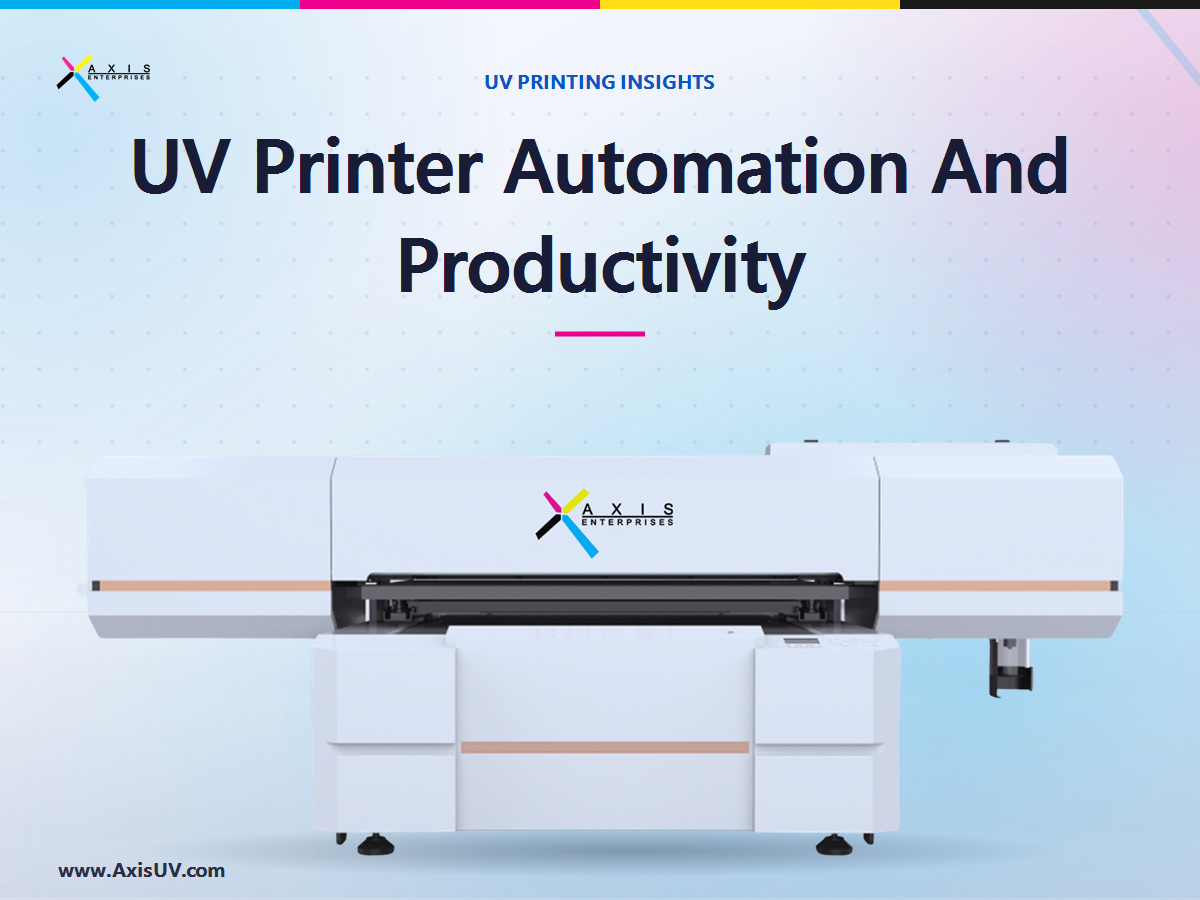
A UV flatbed printer is a form of inkjet printing where ink is cured instantly by ultraviolet light, a process known as UV curing. That one technical fact changes the labour equation in several ways:
- No drying stage. Prints come off the bed finished and handleable. There are no drying racks to manage, no smudged pieces to redo, and no second handling step.
- Direct-to-object printing. The machine prints straight onto acrylic, wood, glass, metal, leather, and finished products. This removes the transfer, lamination, and pasting steps that each need a person.
- One operator, many jobs. Once a job is set, the machine runs unattended. The operator can prepare the next batch, do quality checks, or handle packing while printing happens.
- Repeatable digital files. A repeat order is a file reopened, not a vendor renegotiated. Job setup drops from days of coordination to minutes.
- In-house scheduling. Production follows your order book, not a vendor’s queue, which is what actually shortens delivery promises.
What smart buyers should look for
If reducing manual work and labour cost is the goal, evaluate any machine and supplier against these criteria rather than price alone:
- Unattended-run capability. Ask how long the machine runs reliably without an operator standing at it, and what happens on an ink or media fault.
- Setup and changeover time. The labour saving lives in changeovers. A machine that needs 10 minutes between different products beats one that needs an hour.
- Software workflow. Look for RIP software that stores job templates, so repeat orders need no fresh setup work.
- Training included. Your existing staff should be able to operate it after structured training. If the supplier cannot train your team, the machine will stay dependent on one skilled hire.
- Service response. An automated workflow is only as good as its uptime. Insist on clear service commitments and spare-parts availability in India.
- Full cost picture. Compare machines on total cost of ownership, including ink, maintenance, and power. Remember that for a GST-registered business, the tax paid on a capital machine purchase is generally available as input tax credit, which reduces the effective investment compared to the sticker price. Confirm the treatment with your tax advisor.
A better way forward
This is the point where the equipment decision becomes a supplier decision. At Axis Enterprises we supply UV flatbed printers to Indian printing businesses, signage companies, gift and packaging manufacturers, and industrial product makers, with installation, operator training, and lifetime support built around exactly the criteria above. You can explore UV flatbed printers built for Indian production floors to see which bed sizes and configurations match your product range, or compare machine options against your current outsourcing volumes before you commit to anything.
Frequently asked questions
How can I reduce customer delivery time without hiring more staff?
Bring the printing step in-house and automate it. A UV flatbed printer with instant curing removes vendor queues, transport time, and drying time from your delivery cycle. The same team ships faster because the machine, not additional people, absorbs the production work.
Does a UV printer really reduce labour costs?
It reduces labour per job rather than eliminating jobs. One operator can run the machine while doing other work, and the coordination hours your team currently spends managing vendors largely disappear. Most owners redeploy that time toward sales and quality rather than cutting staff.
How many people are needed to operate a UV flatbed printer?
Typically one trained operator per shift. Loading, starting the job, and unloading are the main manual touches; printing and curing run on their own. Basic file preparation can be learned by existing design or computer staff.
Will my current staff be able to learn the machine?
Yes, with structured training. Daily operation is menu-driven and repeatable, and a supplier who provides installation training plus ongoing support can bring a computer-literate employee to independent operation quickly. You can also arrange a live demo with your own products to see the workflow before deciding.
Is automation worth it for a small business with modest order volumes?
It depends on how many coordination cycles you run, not just print volume. If your team handles frequent small customization jobs through vendors, the saved staff hours and faster delivery often justify the machine earlier than raw print quantity alone would suggest.
Next step
If outsourced coordination is quietly consuming your team’s hours, the practical next move is to put real numbers on it: your monthly outsourced jobs, the staff touches per job, and the delivery days lost. Bring those numbers to a free UV Printing Machine Buying Consultation at uvprinterindia.com and we will help you work out what in-house UV printing would change for your specific workload, with no obligation attached.
Sources
- McKinsey Global Institute: Jobs lost, jobs gained
- ProcessMaker: Repetitive Tasks at Work Research and Statistics 2024
- Nexdigm: India Industrial Automation Market Research Report
- IMARC Group: India Digital Printing Market
- Straits Research: India Print on Demand Market
- Grand View Research: India Digital Printing Market Outlook