

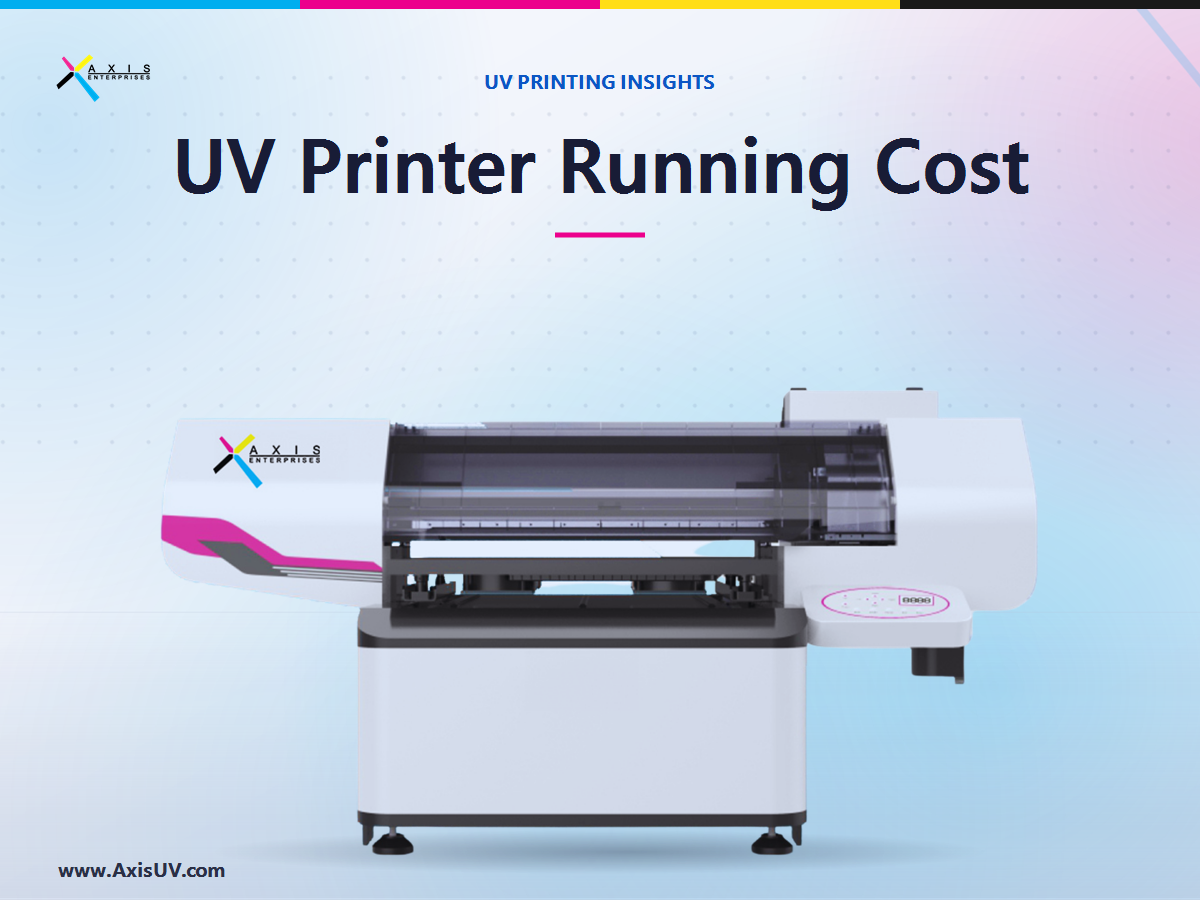
What Does It Actually Cost to Run a UV Printer? The Per-Print Economics Indian Print Businesses Miss Before Buying
Quick answer
The purchase price of a UV printing machine is the smallest cost you will ever pay for it. The number that decides whether the machine makes money is your cost per print: what one finished, sellable piece actually costs you to produce. That figure is built from six things, not one: ink (usually the largest variable, and white ink plus varnish cost more than colour), substrate or media, the power used to run and cure each job, print head upkeep and eventual replacement, a share of the machine cost spread across its output, and operator labour. To it you must add a quiet seventh cost: downtime, because every hour the machine is stopped still has to be paid for by the prints it does produce. Two machines quoted at the same price can have very different cost per print, because a cheaper machine with a thirsty ink system, a short-lived print head, or weak local service can cost more on every single piece over three to five years. So the right way to buy is to calculate cost per print at your real production quality, not to chase the lowest quote. A simple method: (1) estimate ink and substrate cost for one typical job, (2) add a small share of power, maintenance, and machine cost per piece, (3) add labour, then (4) compare that in-house cost per print against what you now pay a vendor for the same piece. Because a UV printer bought for business use is a capital asset, the GST paid on it is generally available as input tax credit (subject to conditions), which lowers the effective machine cost and, spread across output, your cost per print. The goal is not the cheapest machine. It is the lowest true cost per print on the work you already sell.
The number most buyers watch is the smallest one
When a print, signage, or product business shops for a UV printer, almost all of the attention goes to one figure: the quoted price. It is the easiest number to compare, so it becomes the number that decides the purchase. That instinct is exactly backwards, and decades of equipment research say so.
Across industries, the purchase price of a production machine is typically only about 20 to 40 percent of its total lifetime cost. The remaining 60 to 80 percent hides in operating, consumable, maintenance, and training costs that arrive quietly, month after month, long after the invoice is paid (total cost of ownership analyses). In many manufacturing settings, maintenance and running costs consume several times the original purchase price over a machine’s working life, and for energy-intensive equipment, power alone can account for 40 to 60 percent of total cost. The lesson scales down cleanly to a single machine in a single shop: what you pay to buy a printer is a fraction of what you pay to run it.
This matters now because the work a UV printer does is growing fast. The India custom printing market generated about USD 2,451.8 million in revenue in 2024 and is projected to reach roughly USD 4,790.4 million by 2030, a compound annual growth rate of about 11.8 percent, according to Grand View Research, which also notes that India already accounts for about 6.4 percent of the global custom printing market. The machine category reflects the same pull: the global UV flatbed printer market was valued at about USD 1.8 billion in 2025 and is projected to reach about USD 3.6 billion by 2034, with Asia Pacific the largest region at about USD 691 million, or 38.4 percent of 2025 revenue, and India called out as the fastest-growing individual market, with a projected growth rate above 10.2 percent through 2034 (Dataintelo). More owners are buying UV printers than ever. Most are still buying them on the wrong number.
Why the purchase price hides the real cost
A UV printer does not cost you money the way a piece of furniture does, once, at the start. It costs you money every time it runs, and it costs you money every time it does not. Here is where the real spend lives:
- Ink is the recurring heart of the cost. UV ink is priced per litre or per kilogram, and consumption varies widely with coverage, resolution, and how much white ink and varnish a job needs. A machine that lays down ink inefficiently, or that locks you into a single expensive ink supply, quietly raises the cost of every print for the life of the machine.
- Print heads are the priciest wear part. Heads have a working lifespan, and replacing them is one of the largest single running costs a UV printer will ever hand you. A head that lasts longer, or that a supplier can replace quickly and affordably, changes your cost per print more than the sticker price ever did.
- Curing and power add up. UV curing uses energy on every pass. Modern UV LED curing draws less power and lasts far longer than older mercury lamp systems, so two machines with the same output can carry different power and lamp-replacement bills.
- Maintenance and consumables are constant. Cleaning solution, filters, routine servicing, and small spares are ongoing, not optional. Skipping them does not save money, it converts into downtime later.
- Downtime is a cost hidden inside every print. When a single machine stops, billable output stops with it, but rent, salaries, and EMIs do not. Every stopped hour has to be recovered from the prints the machine does make, which raises the true cost of each one.
None of these show up in the quote. All of them show up in your bank balance. A price-first purchase is really a decision to find out your running cost the expensive way, after you have already committed.
What this means for a small print, signage, or product business
For a large factory, a slightly higher running cost is absorbed across huge volume. For an owner-run signage studio, promotional-products unit, gifting or phone-case personalisation business, packaging or label operation, or small manufacturer branding its own products, cost per print lands directly on the margin. This is not a fringe concern: micro, small, and medium enterprises number over 63 million firms and contribute roughly 30 percent of India’s GDP (Ministry of MSME, Government of India), and for almost every one of them, margin is survival.
The trap is specific. A shop compares two machines, one cheaper by a couple of lakh rupees, and takes the saving. Then the cheaper machine turns out to use more ink per job, needs its head replaced sooner, has spares that ship from another city, and sits idle for days when it faults. Within a year, the money saved on the invoice has been paid back several times over in ink, replacements, and lost orders. The cheaper machine was the more expensive machine. It just did not announce it at the till.
How to calculate your real cost per print
You do not need a spreadsheet degree to get this right. You need to cost one typical job honestly, then repeat the method:
- Step 1: Ink and substrate. Estimate the ink used on one representative piece (including white and varnish if the job needs them) and add the cost of the material it prints on. This is your direct cost per print.
- Step 2: A share of machine and power. Take the machine cost, subtract the GST input tax credit you can generally claim on a business capital asset, and spread the balance across the number of prints you realistically expect over its working life. Add a small allowance for power and curing per piece.
- Step 3: Maintenance and heads. Add a per-print allowance for cleaning consumables, routine service, and eventual head replacement. This is the number price-first buyers forget, and it is often the one that decides the winner.
- Step 4: Labour and a downtime buffer. Add the operator’s time per job, then a modest buffer for waste and downtime, because no machine runs perfectly every hour.
- Step 5: Compare. Put your in-house cost per print next to what you currently pay a vendor for the same piece. The gap, multiplied by your real monthly volume, is your monthly saving, and the machine cost divided by that saving is your payback in months.
Run this and one thing becomes obvious: the machine with the lowest quote rarely has the lowest cost per print, and cost per print, not the quote, is what you actually pay for the next five years.
What smart buyers should look for
Once you buy on cost per print rather than sticker price, the checklist changes. Look for:
- Efficient, transparent ink. Clear per-litre pricing, dependable local supply, and no lock-in that lets the cost of ink drift upward after you have committed to the machine.
- Print head longevity and affordable, available replacements. Ask the expected head lifespan, the replacement cost, and how quickly a head can be supplied and fitted locally.
- UV LED curing. Lower power draw and much longer lamp life than older systems, which pulls down both your energy bill and your replacement costs.
- Uptime and reachable service. Fast service response and nearby spare parts, because downtime is a per-print cost. A machine that keeps running is cheaper per print than a faster one that stalls.
- Proper operator training. A trained operator wastes less ink and less material, which lowers cost per print from day one.
- Warranty depth and spares supply. The longer and deeper the support behind the machine, the more predictable your running cost over three to five years.
A better way forward
This is exactly the way we think about UV printing at Axis Enterprises. At uvprinterindia.com, we help Indian print, signage, gifting, packaging, and product businesses choose a UV printing machine on true running cost, not just the quoted price, and we back it with the training, service, and spare-parts support that keep cost per print low and predictable. The aim is simple: a machine that earns more than it costs to run, on the work you already sell.
Next step
If you are weighing a UV printer and want to know your real cost per print before you commit, take the low-risk step first. Book a free UV Printing Machine Buying Consultation at uvprinterindia.com, bring the two or three jobs you print most often, and we will help you work out your in-house cost per print, your likely payback period, and what to look for so you buy the machine that costs the least to run, not just the least to buy.
Frequently asked questions
What is the running cost of a UV printer per print?
There is no single number, because cost per print depends on ink coverage, whether the job needs white ink or varnish, the substrate, and how the machine and maintenance costs are spread across output. The reliable way to find yours is to cost one typical job: ink plus substrate, plus a per-piece share of machine, power, and maintenance, plus labour and a small downtime buffer. Compare that total against what you pay a vendor for the same piece.
Is UV printer ink expensive in India?
UV ink is a recurring cost priced per litre or kilogram, and white ink and varnish cost more than standard colour. What matters more than the headline price is efficiency and supply: a machine that uses ink economically and lets you buy ink from a dependable local source without lock-in will have a lower real ink cost per print than a cheaper machine that consumes more or ties you to costly cartridges.
How long do UV print heads last and what do they cost to replace?
Print heads have a finite working life and are one of the largest single running costs of a UV printer. Lifespan and replacement cost vary by machine and by how well the heads are maintained. Before buying, ask the supplier for the expected head lifespan, the replacement cost, and how quickly a head can be supplied and fitted locally, because a head that is cheap and available changes your cost per print far more than the machine’s quoted price.
Does GST input tax credit apply to a UV printer purchase?
A UV printer bought for business use is treated as a capital asset, and the GST paid on capital goods used in the course of business is generally available as input tax credit, subject to the conditions in the GST law. That credit lowers the effective cost of the machine and, spread across your output, your cost per print. Confirm your specific eligibility with your accountant or tax advisor.
How do I calculate payback on a UV printer?
Add up what you spend outsourcing the jobs you print most often each month. Estimate your in-house cost per print for the same jobs, then multiply the per-piece saving by your monthly volume to get your monthly saving. Divide the machine cost (net of GST input tax credit) by that monthly saving, and the result is your payback period in months. If your repeat volume is real, the payback is usually shorter than owners expect.
Sources
- Grand View Research, India Custom Printing Market Size and Outlook, 2025 to 2030: https://www.grandviewresearch.com/horizon/outlook/custom-printing-market/india
- Dataintelo, Global UV Flatbed Printer Market Research Report 2034: https://dataintelo.com/report/global-uv-flatbed-printer-market
- Deloitte Digital, Personalizing brand experiences: https://www.deloittedigital.com/us/en/insights/research/personalizing-growth.html
- Total cost of ownership analyses (equipment lifecycle cost), Dovient and NetSuite: https://dovient.com/resources/blog/total-cost-of-ownership-equipment
- Ministry of Micro, Small and Medium Enterprises, Government of India: https://msme.gov.in
]]>